 Zum Inhalt springen
 Verantwortung gemeinsam gestalten.
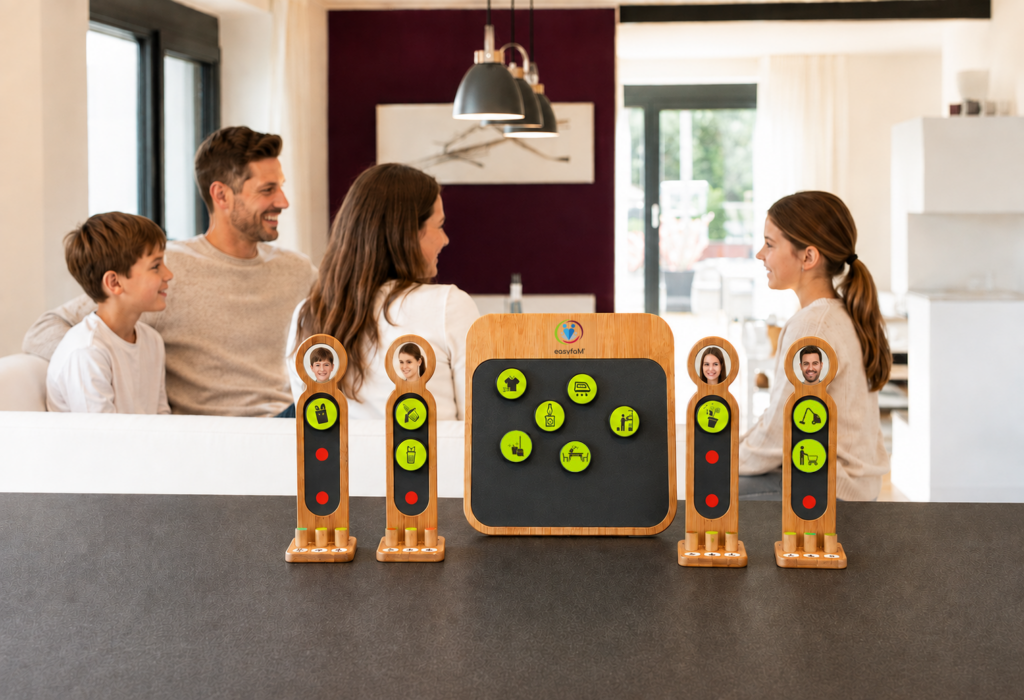
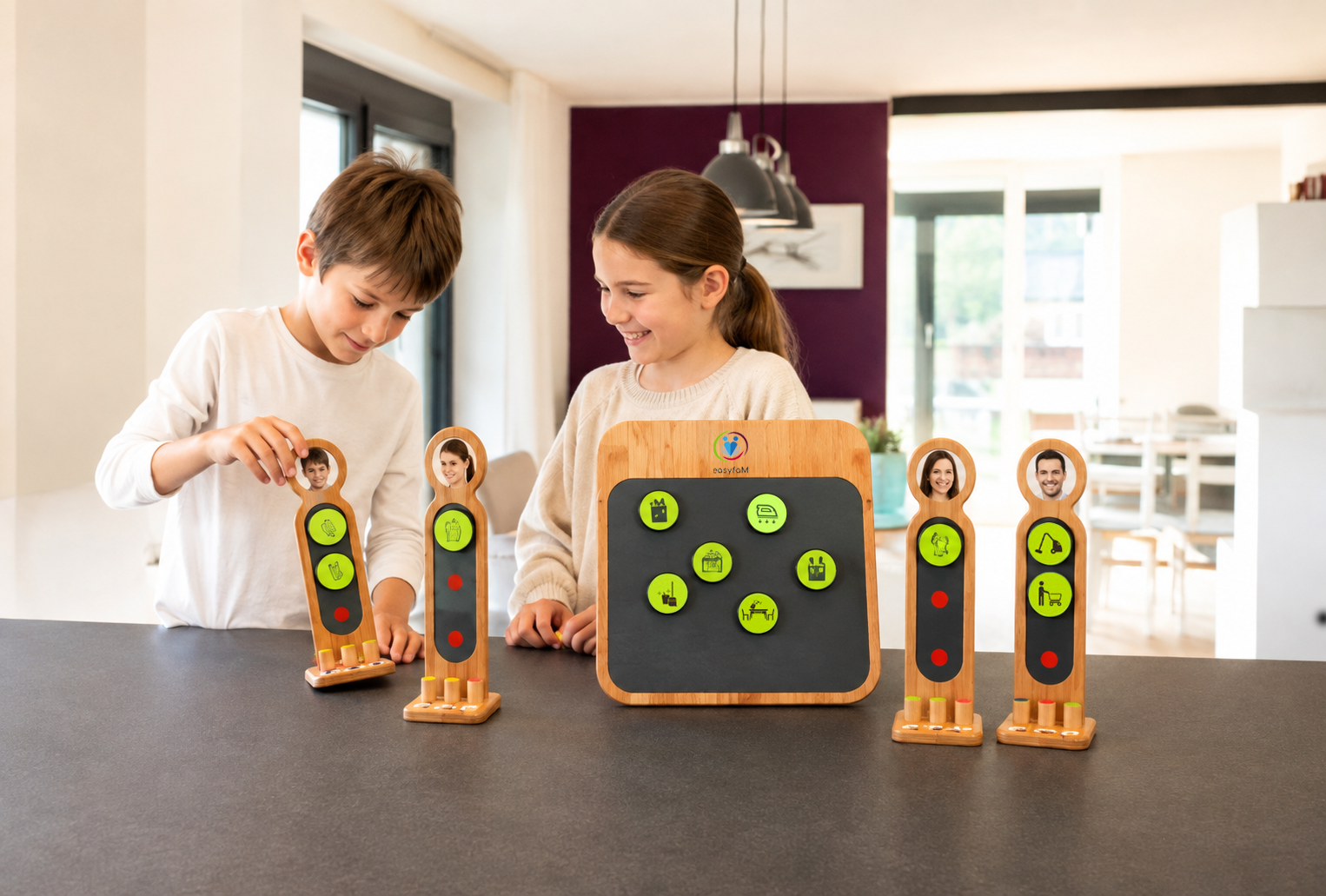
Das easyfaM Taskboard bringt Aufgaben, Zuständigkeiten und Fortschritte aus einzelnen Köpfen in den gemeinsamen Raum. Kinder und Erwachsene gewinnen einen gemeinsamen Überblick und können Verantwortung verlässlicher miteinander tragen.
Du weißt, was noch erledigt werden muss. Ein Teil der Aufgaben ist besprochen, anderes entsteht spontan. Die Kinder könnten längst mehr übernehmen – trotzdem musst du häufig einzeln erklären, erinnern und nachfragen.
Dabei geht es nicht nur darum, wer heute den Tisch deckt oder die Wäsche verteilt. Die eigentliche Koordinationsarbeit liegt darin,
Das easyfaM Taskboard bringt diese Arbeit in einen gemeinsamen, sichtbaren Rahmen. Aufgaben und Beiträge werden nachvollziehbar, Kinder können sich altersangemessen beteiligen und die Familie entwickelt Vereinbarungen, auf die sich alle beziehen können.

Mehr gemeinsamer Überblick.
Konkretere Absprachen. Mehr selbstständige Beteiligung – und weniger tägliche Koordination, die an einer Person hängen bleibt.
Ferienrhythmus als Erprobungsraum
Wenn eingespielte Abläufe lockerer werden, kann Raum entstehen, neue Vereinbarungen in Ruhe auszuprobieren. Der Sommer ist eine besonders passende Gelegenheit – ein guter Start ist zugleich zu jeder Jahreszeit möglich.


Familienorganisation ist kein Selbstzweck. Sie soll Aufmerksamkeit freisetzen, Zusammenarbeit erleichtern und Handlungsspielraum für unterschiedliche Lebensziele schaffen.
Kinder und Erwachsene können Beiträge sichtbar übernehmen. Familienarbeit wird partnerschaftlicher besprechbar – auch zwischen Partnerinnen und Partnern.
Wenn vermeidbare Koordinationsschleifen abnehmen, kann mehr Energie für Beziehung, Erholung, berufliches Engagement, Karriere und persönliche Interessen verfügbar bleiben.
easyfaM bearbeitet den Teil von Vereinbarkeit, den Familien in ihrer eigenen Organisation gestalten können. Gute Arbeitsbedingungen, verlässliche Betreuung und gesellschaftliche Infrastruktur bleiben eigenständige Voraussetzungen.
Die Einsatzmöglichkeiten liegen nicht nur in einzelnen Haushaltstätigkeiten, sondern in den Veränderungen, die Ihr miteinander anstoßen möchtet.
Wenn Aufgaben und Erinnerungen bei einzelnen Personen zusammenlaufen, bringt das Board offene Aufgaben, Zuständigkeiten und Fortschritte in den gemeinsamen Raum.
So entsteht ein geteilter Informationsstand und die mentale Koordination kann breiter getragen werden.
Wenn Kinder mehr übernehmen können, erhalten sie passende Aufgaben, sichtbare Orientierung und echte Entscheidungsspielräume innerhalb eines klaren Rahmens.
Das unterstützt selbstständiges Handeln und reduziert situatives Anweisen.
Wenn Ihr Aufgaben zwischen Erwachsenen neu betrachten möchtet, macht das Board die vorhandene Familienarbeit konkret besprechbar.
Das kann ein sachlicher Einstieg sein, Mental Load und Equal Care gemeinsam zu gestalten – mit Transparenz und Aushandlung statt Schuldzuweisung.
Wenn unterschiedliche Vorstellungen über Zeit, Umfang oder Ergebnis bestehen, schafft das Board einen gemeinsamen Bezugspunkt.
Begriffe wie „später“, „aufgeräumt“ oder „fertig“ können konkret besprochen und als Vereinbarung sichtbar gemacht werden.
Wenn ein Ablauf noch nicht gut zu Euch passt, könnt Ihr das Board für einen kurzen Wochencheck in die Mitte der Familie holen: Was hat funktioniert? Wo war Unterstützung nötig? Was verändern wir?
So entstehen Routinen, die sich mit Eurer Familie weiterentwickeln dürfen.

Das Taskboard verbindet sichtbares Material mit kurzen, wiederkehrenden Absprachen. Seine Wirkung entsteht durch die gemeinsame Nutzung.
Wiederkehrende Wochen- und Tagesaufgaben erhalten einen festen, für alle zugänglichen Ort.
Die Familie bespricht, wer etwas übernehmen kann, welcher Zeitraum gilt und woran „erledigt“ erkennbar ist.
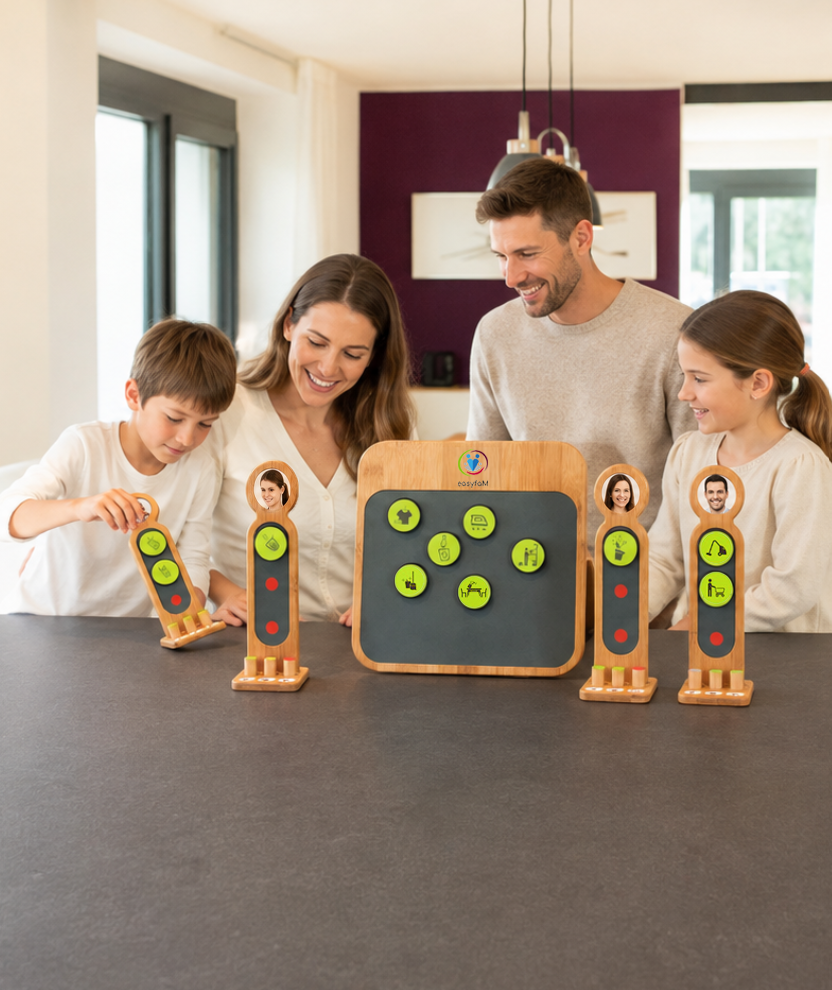
Kinder und Erwachsene wählen oder vereinbaren passende Beiträge und ordnen den Coin ihrer Figur zu.
Aufgaben bewegen sich vom Vorrat über die persönliche Figur bis in den sichtbaren Erledigt-Bereich.
Im kurzen Wochencheck würdigt Ihr Beiträge, besprecht Hindernisse und entwickelt den Ablauf gemeinsam weiter.
Familienorganisation findet häufig in Apps, Kalendern oder im Kopf einzelner Personen statt. Das easyfaM Taskboard gibt ihr einen festen Platz im gemeinsamen Lebensraum.
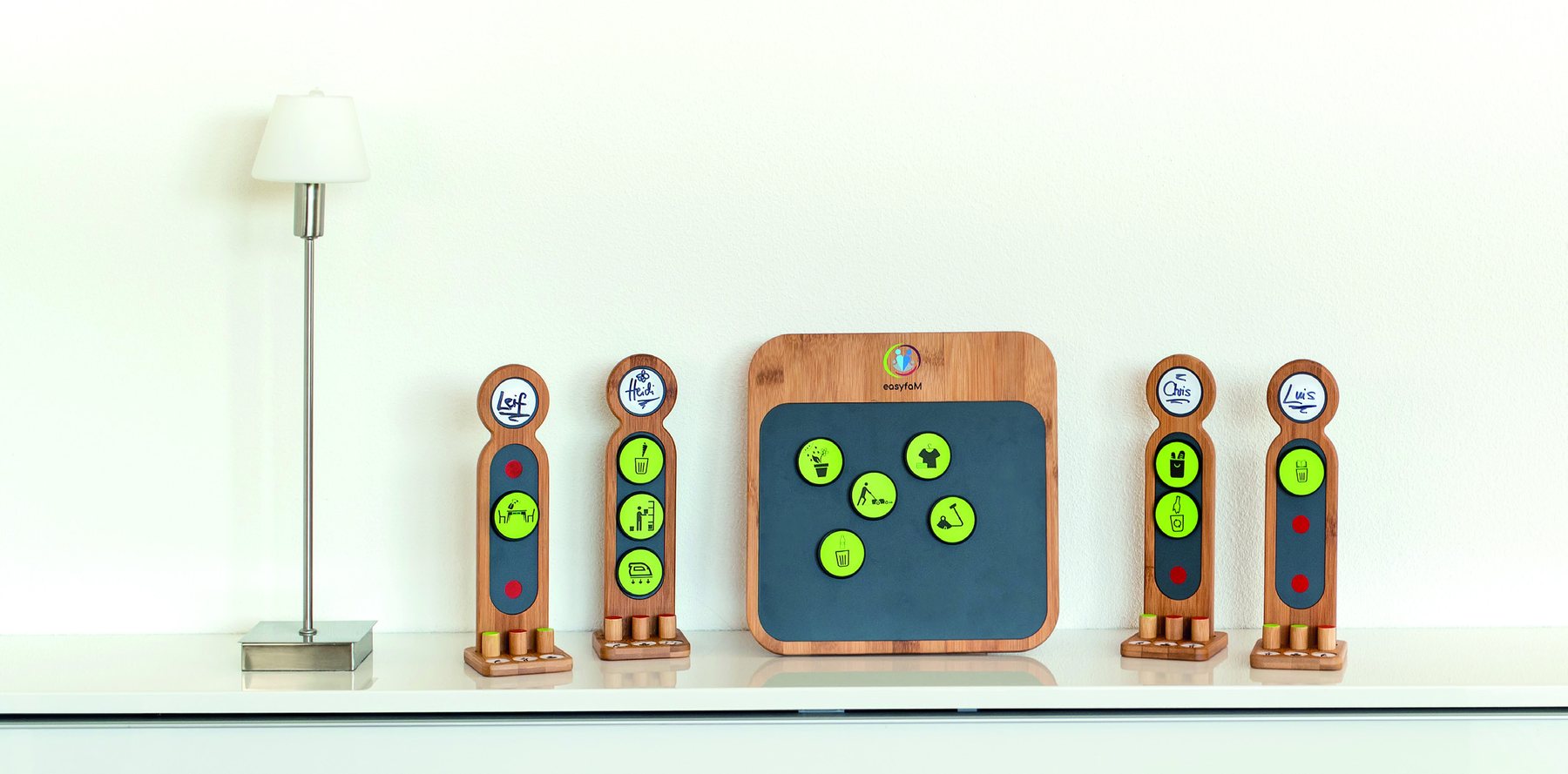
Die Coins können angefasst, ausgewählt und bewegt werden. Die Figuren machen Zuständigkeiten persönlich sichtbar. Das Board bleibt präsent und kann von Kindern und Erwachsenen unmittelbar genutzt werden.


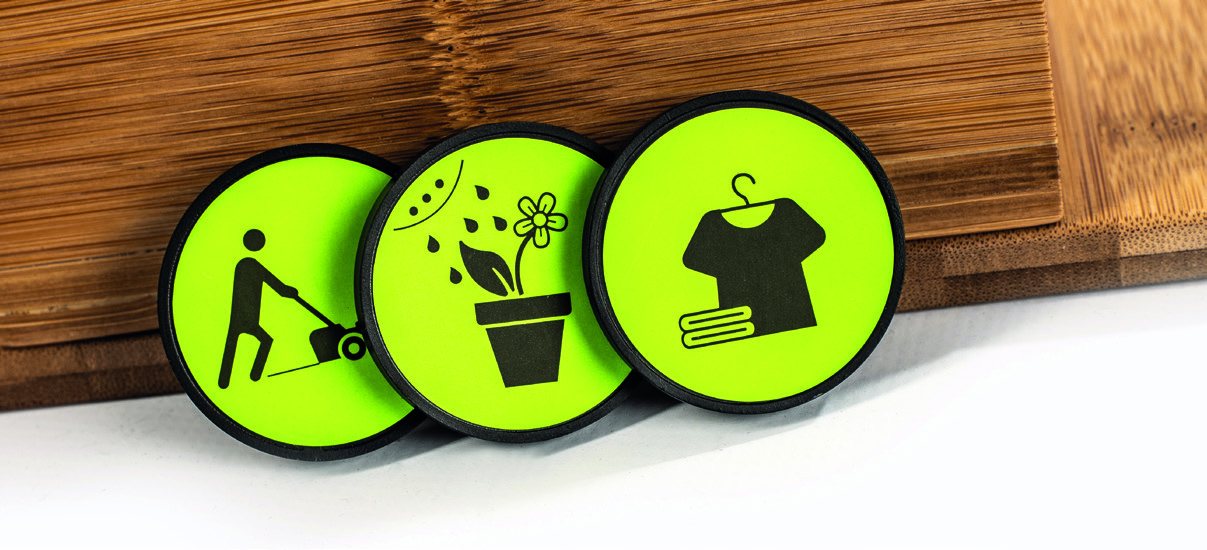
Mit 128 Symbolaufklebern und freien Flächen könnt Ihr wiederkehrende Wochen- und Tagesaufgaben passend zu Eurer Familie abbilden. Die Beispiele zeigen den Inhalt der Coins – die eigentliche Einsatzmöglichkeit liegt in der gemeinsamen Organisation und Beteiligung.
Ein kleiner, gemeinsamer Start schafft Orientierung und lässt Raum zum Lernen und Anpassen.

Verwendet Namen oder Fotos, damit jedes Familienmitglied seine Figur direkt erkennt.

Startet mit wenigen wiederkehrenden Aufgaben und erweitert Euer Set schrittweise.

Besprecht Zuständigkeiten, Zeiträume und das gewünschte Ergebnis gemeinsam.
Stellt das Board sichtbar auf und holt es für Planung oder Rückblick in Eure Mitte.
Die fachliche Tiefe trägt die Anwendung. Auf der Shopseite wird sie knapp sichtbar, ohne das Taskboard zu einem fertigen pädagogischen System zu erklären.
Arbeit sichtbar machen, Verantwortung übernehmen, Erfahrungen auswerten und Abläufe gemeinsam weiterentwickeln.
Eine zugängliche, vorbereitete Umgebung gestalten, in der Kinder zunehmend selbstständig handeln können.
Räume und Materialien als Mitgestalter von Begegnung, Dialog und gemeinsamer Lösungsentwicklung verstehen.
Das Taskboard schafft günstige Bedingungen für Sichtbarkeit, Beteiligung und Reflexion. Es erzeugt Selbstständigkeit, Partnerschaftlichkeit oder Kompetenzen nicht automatisch – entscheidend ist die gemeinsame, passende Anwendung.

1× Vorratsboard mit Standfuß und Verbindungsschrauben
4× persönliche Figuren mit Standfüßen
12× Holz-Pins mit grüner und roter Stirnseite
20× Magnet-Coins
128× Aufkleber: 70 grüne und 58 weiße
1×Anleitung für Aufbau, Vorbereitung und Wochencheck
Das Grundset ist für bis zu vier Personen ausgelegt. Für weitere Familienmitglieder gibt es ein Ergänzungsset.
Alter und Sicherheit: Besonders geeignet für Familien mit Kindern ab etwa fünf Jahren. Das Organisationstool enthält Kleinteile und ist nicht für Kinder unter vier Jahren geeignet.
Konkrete Nutzungserfahrungen sind aussagekräftiger als pauschale Wirkversprechen.

DER SPIEGEL
Eine externe Perspektive kann zeigen, wie Aufbau, Material und Nutzung praktisch erlebt werden.
Klare Antworten unterstützen eine realistische Kaufentscheidung und zeigen, wie flexibel das Taskboard eingesetzt werden kann.
Besonders geeignet ist es für Familien mit Kindern ab etwa fünf Jahren. Entscheidend ist, dass das Kind die Symbole versteht und die verwendeten Kleinteile sicher handhaben kann.
Nein. Familien können zwischen freier Wahl, gemeinsamer Vereinbarung und klar zugeordneten Aufgaben unterscheiden. Wichtig ist, dass Entscheidungsräume verständlich sind und zum Alter passen.
Ja. Auch die Aufgaben und Beiträge der Erwachsenen können sichtbar werden. Das Board kann damit einen sachlichen Ausgangspunkt schaffen, Familienarbeit und Mental Load gemeinsam zu betrachten und neu zu vereinbaren.
Das Taskboard ist in erster Linie ein Organisations- und Beteiligungstool. Erledigte Aufgaben werden sichtbar und können gewürdigt werden. Zusätzliche Belohnungen sind für seine Grundfunktion nicht erforderlich.
Das Board ersetzt keine Aushandlung. Widerstand kann auf eine unklare Aufgabe, einen ungünstigen Zeitpunkt, Überforderung oder fehlende Beteiligung hinweisen. Beginnt mit wenigen Aufgaben und besprecht gemeinsam, was tragfähig ist.
easyfaM greift ausgewählte Ideen aus Montessori und Reggio auf und überträgt sie eigenständig auf die Organisation des Familienalltags. Das Taskboard beansprucht nicht, ein vollständiges Montessori- oder Reggio-Konzept zu sein.
Ja. Mit dem Ergänzungsset kann das Taskboard um zwei weitere Figuren und zusätzliches Material erweitert werden.
Startet mit wenigen Aufgaben, entwickelt passende Vereinbarungen und schafft einen gemeinsamen Ort für Familienarbeit, Beteiligung und Rückblick.
easyfaM Erklärung zur Barrierefreiheit
We firmly believe that the internet should be available and accessible to anyone, and are committed to providing a website that is accessible to the widest possible audience, regardless of circumstance and ability.
To fulfill this, we aim to adhere as strictly as possible to the World Wide Web Consortium’s (W3C) Web Content Accessibility Guidelines 2.1 (WCAG 2.1) at the AA level. These guidelines explain how to make web content accessible to people with a wide array of disabilities. Complying with those guidelines helps us ensure that the website is accessible to all people: blind people, people with motor impairments, visual impairment, cognitive disabilities, and more.
This website utilizes various technologies that are meant to make it as accessible as possible at all times. We utilize an accessibility interface that allows persons with specific disabilities to adjust the website’s UI (user interface) and design it to their personal needs.
Additionally, the website utilizes an AI-based application that runs in the background and optimizes its accessibility level constantly. This application remediates the website’s HTML, adapts Its functionality and behavior for screen-readers used by the blind users, and for keyboard functions used by individuals with motor impairments.
If you’ve found a malfunction or have ideas for improvement, we’ll be happy to hear from you. You can reach out to the website’s operators by using the following email
Our website implements the ARIA attributes (Accessible Rich Internet Applications) technique, alongside various different behavioral changes, to ensure blind users visiting with screen-readers are able to read, comprehend, and enjoy the website’s functions. As soon as a user with a screen-reader enters your site, they immediately receive a prompt to enter the Screen-Reader Profile so they can browse and operate your site effectively. Here’s how our website covers some of the most important screen-reader requirements, alongside console screenshots of code examples:
Screen-reader optimization: we run a background process that learns the website’s components from top to bottom, to ensure ongoing compliance even when updating the website. In this process, we provide screen-readers with meaningful data using the ARIA set of attributes. For example, we provide accurate form labels; descriptions for actionable icons (social media icons, search icons, cart icons, etc.); validation guidance for form inputs; element roles such as buttons, menus, modal dialogues (popups), and others. Additionally, the background process scans all the website’s images and provides an accurate and meaningful image-object-recognition-based description as an ALT (alternate text) tag for images that are not described. It will also extract texts that are embedded within the image, using an OCR (optical character recognition) technology. To turn on screen-reader adjustments at any time, users need only to press the Alt+1 keyboard combination. Screen-reader users also get automatic announcements to turn the Screen-reader mode on as soon as they enter the website.
These adjustments are compatible with all popular screen readers, including JAWS and NVDA.
Keyboard navigation optimization: The background process also adjusts the website’s HTML, and adds various behaviors using JavaScript code to make the website operable by the keyboard. This includes the ability to navigate the website using the Tab and Shift+Tab keys, operate dropdowns with the arrow keys, close them with Esc, trigger buttons and links using the Enter key, navigate between radio and checkbox elements using the arrow keys, and fill them in with the Spacebar or Enter key.Additionally, keyboard users will find quick-navigation and content-skip menus, available at any time by clicking Alt+1, or as the first elements of the site while navigating with the keyboard. The background process also handles triggered popups by moving the keyboard focus towards them as soon as they appear, and not allow the focus drift outside it.
Users can also use shortcuts such as “M” (menus), “H” (headings), “F” (forms), “B” (buttons), and “G” (graphics) to jump to specific elements.
We aim to support the widest array of browsers and assistive technologies as possible, so our users can choose the best fitting tools for them, with as few limitations as possible. Therefore, we have worked very hard to be able to support all major systems that comprise over 95% of the user market share including Google Chrome, Mozilla Firefox, Apple Safari, Opera and Microsoft Edge, JAWS and NVDA (screen readers).
Despite our very best efforts to allow anybody to adjust the website to their needs. There may still be pages or sections that are not fully accessible, are in the process of becoming accessible, or are lacking an adequate technological solution to make them accessible. Still, we are continually improving our accessibility, adding, updating and improving its options and features, and developing and adopting new technologies. All this is meant to reach the optimal level of accessibility, following technological advancements. For any assistance, please reach out to