

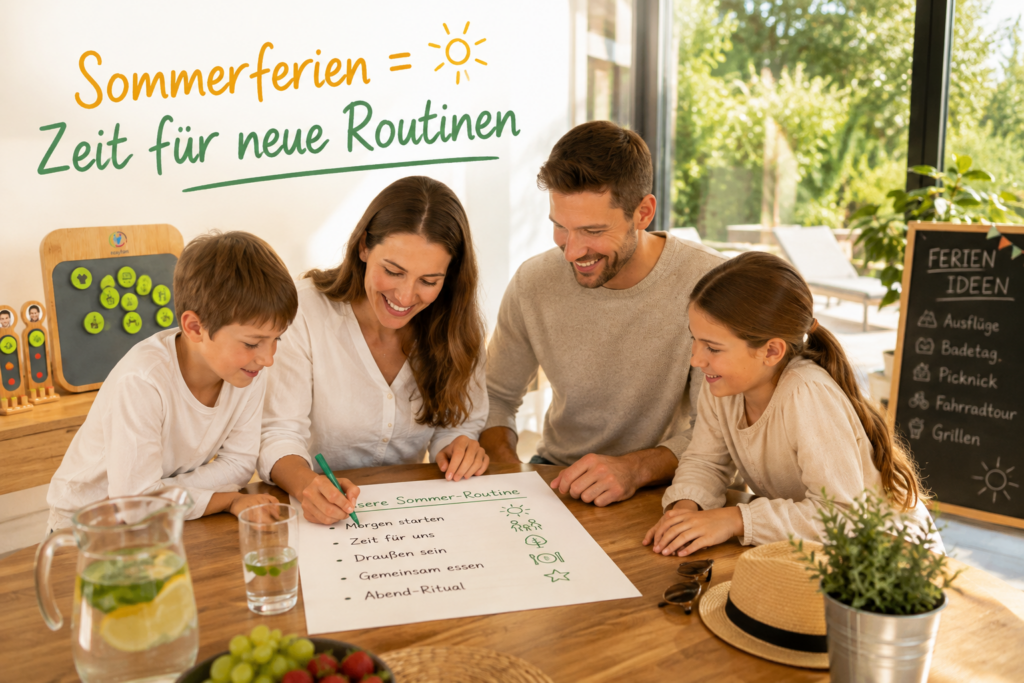
… trying out new routines in family life
Summer holidays change family life. School and daycare take a break or operate differently, childcare hours shift, vacations and trips are added – and many of the routines that usually carry you through the week are thrown into flux anyway.
For working parents, this often means additional coordination at first: Who works when? Who takes over which childcare duties? What’s on the agenda today? And who is actually thinking of all the little things that need to be done on the side?
At the same time, this is exactly where an interesting opportunity lies.
Because when daily life is running differently anyway, it’s easier to try out new routines.
Holidays interrupt the usual rhythm
In normal school and work life, many routines mesh together automatically. Waking up, breakfast, brushing teeth, school bag, daycare, work, shopping, dinner, tidying up, bedtime.
This is helpful – and at the same time, it creates fixed habits. Responsibilities have become established, some things are handled spontaneously, and much eventually stops being consciously discussed.
Holidays create an interruption.
The daily schedule becomes more fluid. Some tasks disappear, others are added. This creates a good moment to take a closer look:
Which routines actually carry us well through the day? Which tasks can children already take on? What do we want to regulate more clearly together?
New routines can start small
A new family organization doesn’t have to become a major holiday project.
Often it’s enough to start with a few recurring tasks.
For example:
- putting away your own pajamas in the morning,
- helping to clear the table after a meal,
- watering plants,
- helping to prepare the backpack for a trip,
- putting toys back in their place in the evening.
The decisive factor is not so much the number of tasks as the shared experience: We make what needs to be done visible, distribute responsibility, and see together how it works.
This is how an idea turns into a routine, step by step.
Visibility facilitates participation
This is exactly where the easyfaM Taskboard comes in.
Tasks become visible with pictures. Children and adults can see what needs to be done and who is currently taking care of something. Instead of many small shouts and reminders, a shared point of reference is created in everyday family life.
This opens up conversations:
- “What would you like to take on?”
- “What does it take for us to consider the task finished?”
- “Do we still need support with this?”
- “How did it work this week?”
This turns family organization into something that can be shaped together.
Holidays become a testing ground
For us, that is the real charm of the summer holidays.
It’s less about developing a perfect routine for the holidays. Much more interesting is the opportunity to test small changes in a more flexible daily life.
- What works well?
- Where do children still need support?
- Which task might even be fun?
- Which agreement helps the adults?
- And which routine do we want to keep even after the holidays?
In this way, trying things out becomes a small learning loop: try, observe, discuss, and refine.
And after the holidays?
With the start of school or daycare, daily life changes again. Then the family can look together at which experiences from the summer should come along.
- Maybe a new morning routine stays.
- Maybe a child takes on a certain task permanently.
- Maybe a short joint check-in at the Taskboard has proven its worth.
- And maybe some things will be reorganized once more.
That’s exactly why the summer holidays are a good time for many families to start with a few tasks, try out new routines, and find out together what works in their own daily lives.
Want to try it for yourself?
The easyfaM Taskboard makes tasks, responsibilities, and progress in everyday family life visible and invites children and adults to shape responsibility together.