

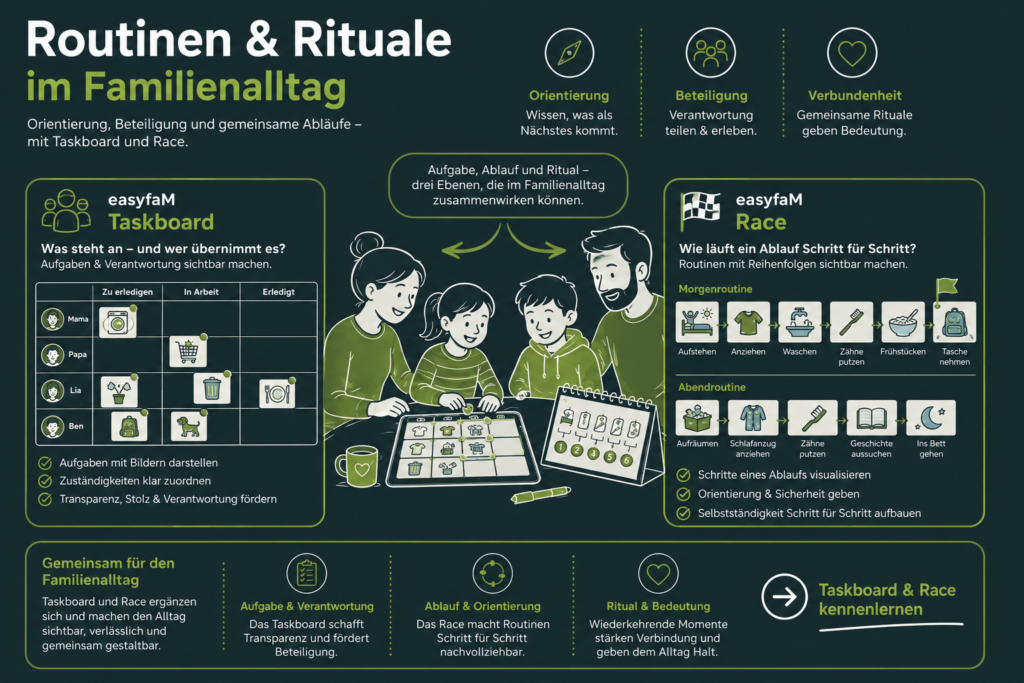
Orientation & involvement through shared routines
Some things happen in families every day.
Getting up. Getting dressed. Having breakfast. Brushing teeth. Gathering things. Eating. Tidying up. Going to bed.
Other things come around every week: laundry, shopping, taking out the trash, tidying rooms, or getting ready for the week ahead.
You can find a quick solution for every single situation. But in the long run, it helps families when certain routines become familiar and everyone involved knows what they can rely on.
Routines and rituals give everyday family life structure, orientation, and a sense of familiarity—and at the same time create space for involvement and shaping things together.
Routines make processes familiar
A routine is, first of all, a recurring sequence.
The more often an action happens in a similar way, the more familiar it becomes. Children develop a sense of what’s involved and what comes next. Adults need less on-the-spot coordination and can increasingly share responsibility.
Typical transitions in everyday family life are especially well suited for this: starting the morning, coming home, eating dinner together, or heading to bed.
Over time, many individual actions can turn into a familiar routine.
That’s how routines create orientation in the small things.
Rituals give repetition meaning
Rituals have a slightly different function.
They repeat too. At the same time, they often include a social or emotional moment.
That could be the bedtime story, dinner together, a short weekend check-in, or the evening question: “What was nice today?”
A regular family check-in around shared organization can also take on a ritual character over time:
What’s coming up over the next few days?
Who would like to take on which task?
What worked well?
What do we want to change next time?
The routine itself can be short. Its meaning comes from repetition and experiencing it together.
Tasks and routines are two different things
When it comes to family organization, it’s worth making one important distinction.
Sometimes it’s about which tasks need doing and who takes responsibility for them.
And sometimes it’s about how a recurring routine works step by step.
This is exactly where the easyfaM Taskboard and the easyfaM Race take different approaches.
The Taskboard: What needs doing—and who’s taking it on?
The easyfaM Taskboard makes tasks and responsibilities visible.
Which tasks are part of our everyday family life? Who’s taking on what? What’s currently in progress? What’s already done?
Tasks are shown with pictures and assigned to family members. This creates a shared reference point where children and adults can see what needs doing day to day and who is currently taking responsibility.
That also changes the basis for conversations.
Instead of “You still have to …”, it can become a shared question:
“What still needs doing today?”
Instead of assigning tasks on the fly, it becomes:
“Who’s doing what?”
And a completed task becomes visible as:
“I did that.”
Especially for children, this visibility can help them recognize their own contribution to everyday family life and gradually take on more responsibility.
The Race: How does a routine work step by step?
With a morning routine, a different question comes up.
Here it’s often less about who takes on a task, and more about which steps belong together in sequence.
For example:
Get up → get dressed → wash → brush teeth → have breakfast → grab your bag → head out.
In the evening, the sequence can look quite different:
Tidy up → put on pajamas → brush teeth → choose a story → go to bed.
This is exactly where the easyfaM Race comes in.
It helps make the individual steps of a recurring routine visible. Children can use it to see what they’ve already done and what comes next.
That gives a routine a clear, easy-to-follow structure.
So the Taskboard mainly makes tasks and responsibility visible. The Race helps make recurring routines familiar step by step.
Both can complement each other well in everyday family life.
Involvement needs clarity
Involving children means more than giving them tasks.
It helps to clarify together what a task—or a single step—actually means.
“Tidy your room” can mean something completely different to a child than it does to an adult.
That’s why one simple question is worth asking:
“How will we know together that this task is done?”
Maybe setting the table means: plates, cutlery, and glasses are on the table.
Maybe packing the school bag means: homework, pencil case, water bottle, and sports kit are packed.
And maybe “ready for school” consists of five small steps that become visible on the Race.
Agreements like these create orientation and make it easier for children to take on tasks and routines more independently over time.
Routines can grow with the family
Families are constantly changing.
Children get older. School starts. Working hours change. Childcare is reorganized. Skills keep developing.
That’s why we see routines less as rigid rules and more as answers developed together for recurring everyday situations.
What works well today can look different in a few months.
Maybe a child needs five visible steps for the morning routine at first—and later only two.
Maybe over time they take on tasks on the Taskboard that a parent used to support them with.
And maybe, during a family check-in, you realize: We can simplify this routine now.
That’s how growth happens in everyday life: try, observe, talk it through, and adjust.
Three levels that can work together
One simple everyday situation shows the difference especially well.
Let’s take the morning before school or daycare:
Taskboard – task and responsibility:
Who prepares the lunchbox? Who sets the breakfast table? What does the child already do on their own?
Race – routine and orientation:
Get up → get dressed → wash → brush teeth → have breakfast → grab your bag.
Ritual – connection and meaning:
Maybe it ends with a mindful goodbye, a hug, or a shared phrase to start the day.
Task, routine, and ritual serve different functions—and can complement each other in everyday family life.
Start small
To get started, you don’t need a completely reorganized family life.
A good start is one specific everyday situation.
If it’s about making tasks visible and distributing them among family members, the Taskboard can be a great way to begin.
If it’s about a recurring routine with several steps—for example in the morning before school or daycare, or in the evening before bed—the Race starts exactly there.
And sometimes the first step is simply introducing a small shared habit that matters to your family.
Then it’s about:
trying it out, observing, and figuring out together what fits your everyday life.
Because good routines are rarely designed at a desk. They develop where families gain experience together and keep refining their routines step by step.
Make everyday family life visible—and shape it together
With Taskboard and Race, different sides of everyday family life become visible:
The Taskboard helps you organize tasks and responsibility together.
The Race gives recurring routines a clear, easy-to-follow structure.
Together, these materials can help children and adults further develop orientation, involvement, and independence in everyday life—tailored to each family and life stage.
→ Get to know Taskboard & Race—head to the shop